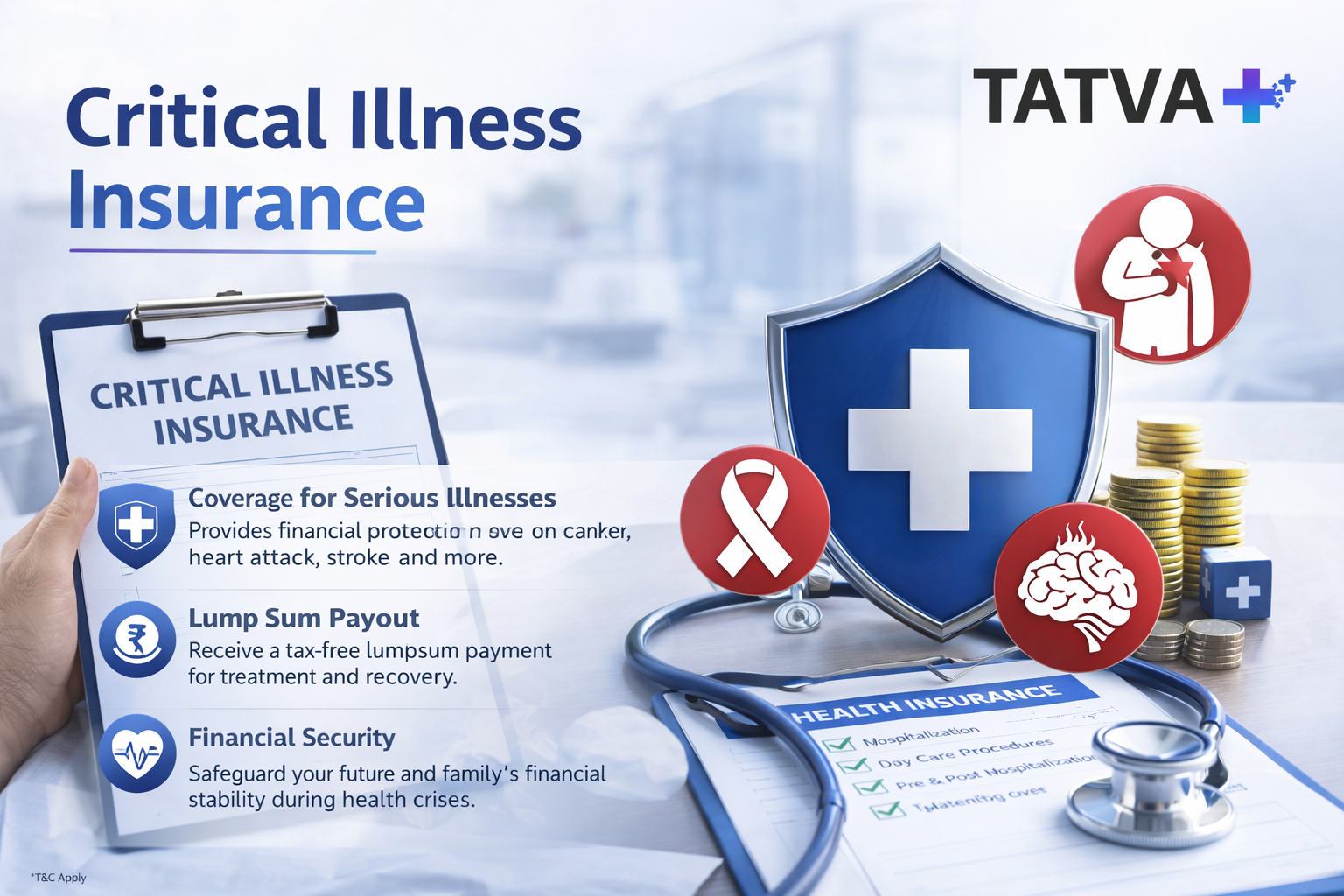
Ravi, 38, was diagnosed with stage 2 kidney cancer. His health insurance paid for the surgery and hospital stay — approximately Rs. 4.5 lakhs. But what health insurance did not cover: six months of recovery, inability to work, alternative therapies, a home nurse, dietary supplements, psychological counselling, and lost income. Total financial impact: Rs. 18 lakhs. This is the gap that critical illness insurance fills.
What is Critical Illness Insurance?
Critical illness insurance pays a fixed lump sum on the diagnosis of a specified serious medical condition — regardless of the actual treatment cost.
Key Distinction: Regular health insurance pays your hospital bills. Critical illness insurance pays YOU — a lump sum to use for anything: treatment, lost income, EMIs, recovery, or home modifications. This lump sum is paid on diagnosis, not only after hospitalisation.
Ready to Make a Smarter Health Decision?
Let a TatvaPlus expert help you find the right health insurance plan for your age, health profile, and budget — at absolutely no cost to you.
What Conditions Does Critical Illness Insurance Cover?
| Category | Conditions Typically Covered |
|---|
| Cardiovascular | Heart attack, open heart surgery, heart valve replacement, aorta surgery |
| Cancer | All major cancers of specified severity |
| Neurological | Stroke, multiple sclerosis, Parkinson's, Alzheimer's, motor neurone disease |
| Organ-related | Kidney failure requiring dialysis, liver failure, loss of limbs |
| Respiratory | Primary pulmonary hypertension, lung failure |
| Others | Aplastic anaemia, coma, total blindness, deafness, paralysis, major organ transplant |
Critical Illness vs Regular Health Insurance
| Feature | Health Insurance | Critical Illness Insurance |
|---|
| What it pays | Actual hospitalisation bills | Fixed lump sum on diagnosis |
| Payout trigger | Hospitalisation | Diagnosis of listed condition |
| Use of payout | Medical bills only | Anything — income, recovery, EMIs |
| Covers lost income | No | Yes (via lump sum) |
| Claim process | Bill-by-bill | Single lump-sum payment |
Why a Regular Health Plan is Not Enough
- Lost income: If you cannot work for 3–12 months, your health plan pays nothing. EMIs and household expenses do not stop.
- Recovery and rehabilitation: Physiotherapy, home nursing, dietary support — largely out of pocket.
- Home modifications: Wheelchair ramps, bathroom changes after a stroke — not covered.
- Advanced treatments: Proton beam therapy, immunotherapy — often excluded or capped.
The Real Cost: Medical bills are often just 30–40% of the total financial impact of a critical illness. The remaining 60–70% comes from income loss, recovery, and lifestyle adjustments — none of which health insurance covers.
Ready to Make a Smarter Health Decision?
Let a TatvaPlus expert help you find the right health insurance plan for your age, health profile, and budget — at absolutely no cost to you.
Who Needs Critical Illness Insurance?
- Sole or primary earner: Your family's survival depends on your income. Protect it.
- Strong family history: Cancer, heart disease, or diabetes in close relatives significantly increases your risk.
- Home loan or major liabilities: A 6-month income gap can trigger a debt spiral. A lump sum prevents it.
- High-stress profession: Stress-linked conditions like heart disease are rising among young professionals.
How Much Cover Do You Need?
- Aim for 3–5 times your annual income in critical illness cover
- If you earn Rs. 10 lakhs/year, aim for Rs. 30–50 lakhs
- Add total outstanding loans to this calculation
- Factor in average recovery time: cancer 6–24 months, heart attack 3–12 months, stroke 6–24 months
Standalone Plan vs Rider
| Feature | Critical Illness Rider | Standalone Plan |
|---|
| Coverage amount | Typically limited | Can be Rs. 50L to Rs. 1Cr+ |
| Conditions covered | 15–20 conditions | 20–64+ conditions |
| Flexibility | Linked to base plan | Independent, flexible tenure |
| Recommended for | Supplemental coverage | Primary CI protection |
Ready to Make a Smarter Health Decision?
Let a TatvaPlus expert help you find the right health insurance plan for your age, health profile, and budget — at absolutely no cost to you.
Frequently Asked Questions
Is critical illness insurance the same as health insurance?
No. Health insurance covers hospital bills. Critical illness insurance pays a fixed lump sum on diagnosis — regardless of actual hospital costs. The lump sum can be used for anything: income replacement, recovery, loan repayment.
Can I have both health insurance and critical illness insurance?
Yes — and you should. They are complementary, not alternatives. Health insurance covers your medical bills; critical illness provides financial security for everything else during recovery.
At what age should I buy critical illness insurance?
The earlier the better. Premiums are significantly lower for younger buyers. The 30–40 age range is increasingly common for purchase.
Can critical illness premiums be claimed under Section 80D?
Yes. Premiums for standalone critical illness policies are eligible for Section 80D deduction within the same limits as regular health insurance premiums.